2026 MCCM 2.0+(23 Variables Ver.): April 12
Powered by AIPAMS (Adaptive Integrated Policy & Analytics Modeling System)
1. Introduction
The 2026 U.S. & Allies–Iran Conflict Cost Monitor (MCCM v2.0+) 23-variable system captures escalation as a multi-layered, networked, and perception-mediated process, where pressure accumulation, transmission coupling, capability adaptation, and threshold proximity jointly determine the system’s trajectory toward or away from loss of control (LoCT).
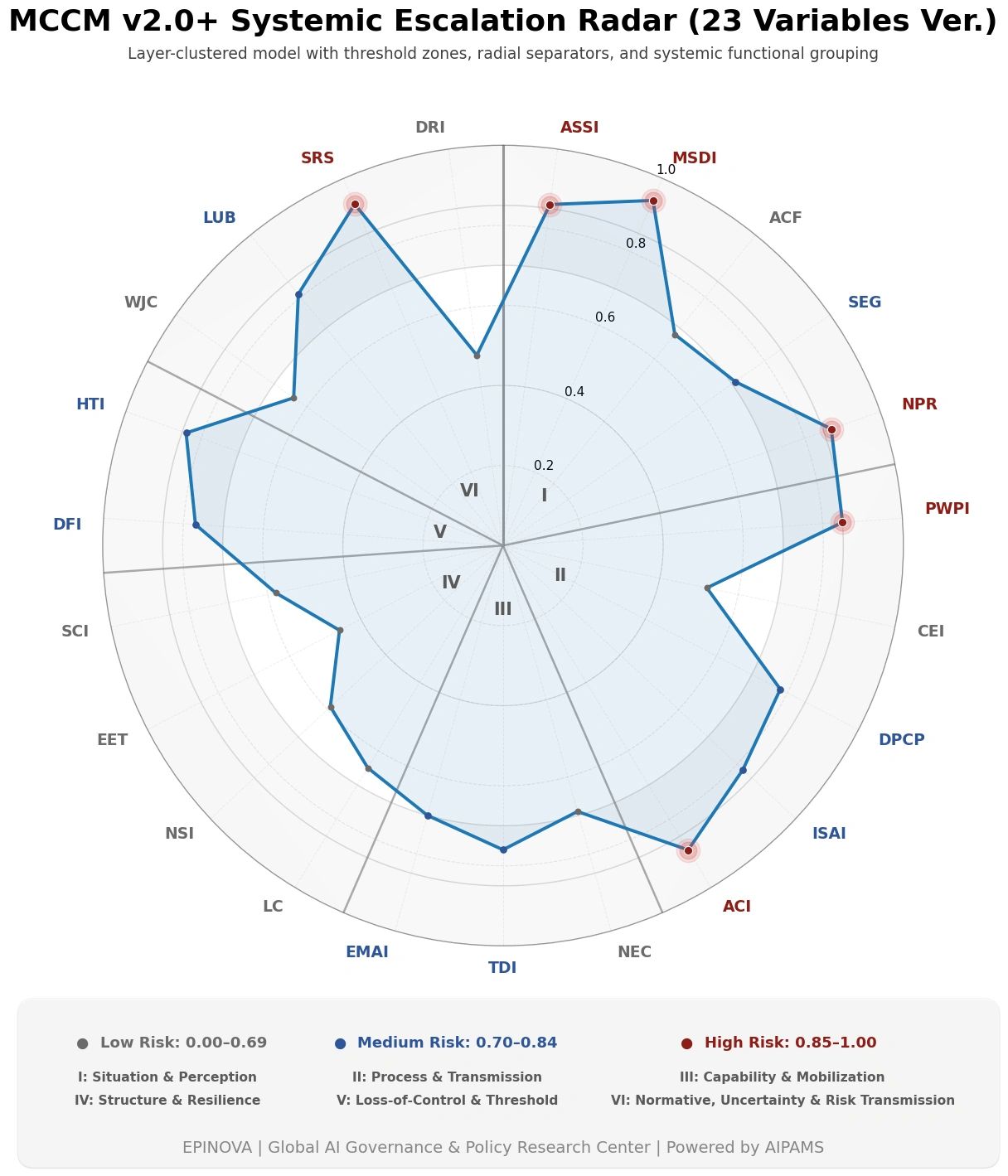
2. Methodological Notes
I. Situation & Perception Layer
1. ASSI — Aggregate Strategic Stress Index
Captures the aggregate level of systemic stress across military, political, economic, and informational domains, reflecting overall escalation pressure accumulation.
2. MSDI — Military Situation Deterioration Index
Measures the rate and magnitude of battlefield deterioration, including loss of initiative, force degradation, and unfavorable operational shifts.
3. ACF — Alliance Cohesion Factor
Assesses the degree of alignment, coordination, and reliability within alliance structures under stress conditions.
4. SEG — Strategic Escalation Gradient
Represents the slope and acceleration of escalation, distinguishing between incremental escalation and discontinuous jumps.
5. NPR — Narrative Polarization Rate
Measures the speed and intensity of divergence in information narratives across actors and audiences.
II. Process & Transmission Layer
6. PWPI — Proxy Warfare Pressure Index
Evaluates the intensity and expansion of proxy-based conflict activities and their amplification effect on the system.
7. CEI — Cyber Escalation Index
Measures the scale and intensity of cyber operations and their contribution to escalation dynamics.
8. DPCP — Disruption of Physical Connectivity Pressure
Captures disruption to logistics, infrastructure, and supply chains affecting system stability.
9. ISAI — Information System Amplification Index
Quantifies amplification effects in information ecosystems, including virality, signal spikes, and narrative cascades.
10. ACI — Actor Coupling Index
Measures the degree of interdependence and synchronization among actors, reflecting how shocks propagate across the network.
III. Capability & Mobilization Layer
11. NEC — Net Effective Capability
Represents the usable and deployable capability after accounting for losses, constraints, and operational frictions.
12. TDI — Temporal Deployment Intensity
Measures the rate at which forces and resources are mobilized and deployed over time.
13. EMAI — Economic Mobilization & Adaptation Index
Captures the ability of an economy to sustain war efforts, reallocate resources, and adapt under pressure.
IV. Structure & System Resilience Layer
14. LC — Logistics Capacity
Measures the throughput and sustainability of logistical systems supporting operations.
15. NSI — Network Stability Index
Assesses the robustness and coherence of networked operational and alliance structures.
16. EET — Energy & Economic Throughput
Measures the flow and stability of energy supply and economic activity under conflict conditions.
17. SCI — Systemic Coordination Index
Captures the ability of the system to coordinate across domains, actors, and time horizons.
V. Loss-of-Control & Threshold Layer
18. DFI — Decision Friction Index
Measures delays, inconsistencies, and inefficiencies in decision-making under stress.
19. HTI — Hard Threshold Index
Represents proximity to irreversible escalation thresholds (e.g., regional war, direct state-on-state expansion).
VI. Normative, Uncertainty & Risk-Transmission Extension
20. WJC — War Justification Coherence
Measures internal and external coherence of justification narratives sustaining political legitimacy.
21. LUB — Latent Uncertainty Band
Captures the range of unknowns, ambiguity, and information gaps affecting decision-making.
22. SRS — State Risk Signaling
Measures explicit and implicit signaling of escalation intent by state actors (e.g., red lines, alerts, deployments).
23. DRI — De-risking & Restraint Index
Captures efforts to limit escalation, including diplomatic engagement, force restraint, and de-escalatory signaling.
Share this post: