2026 U.S. & Allies–Iran Conflict Cost Monitor (MCCM): April 11
Powered by AIPAMS (Adaptive Integrated Policy & Analytics Modeling System)
1. Introduction
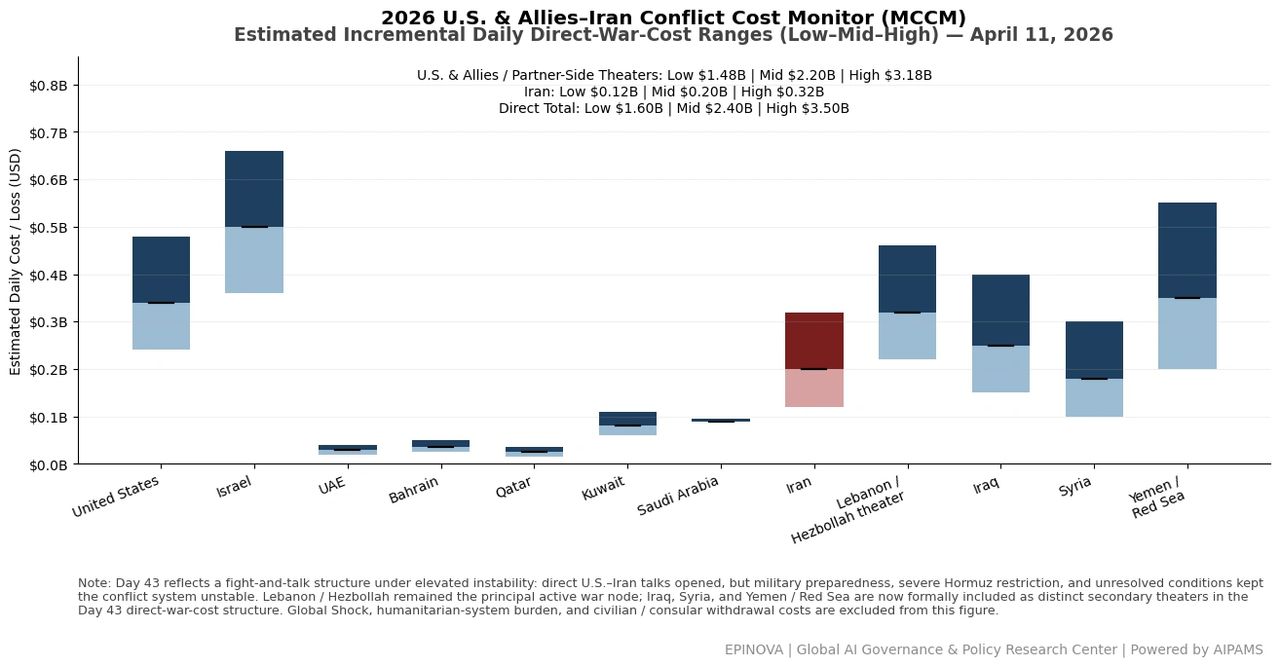
The 2026 Middle East Conflict Cost Monitor (MCCM) provides an event-driven, scenario-based assessment of daily conflict-related expenditures and losses across major state actors involved in the crisis. Using a structured low–mid–high estimation framework, the series aggregates publicly available operational indicators, force posture changes, strike intensity proxies, reported material damage, and infrastructure disruptions to produce comparable daily cost ranges.
The MCCM framework distinguishes between three analytical components:
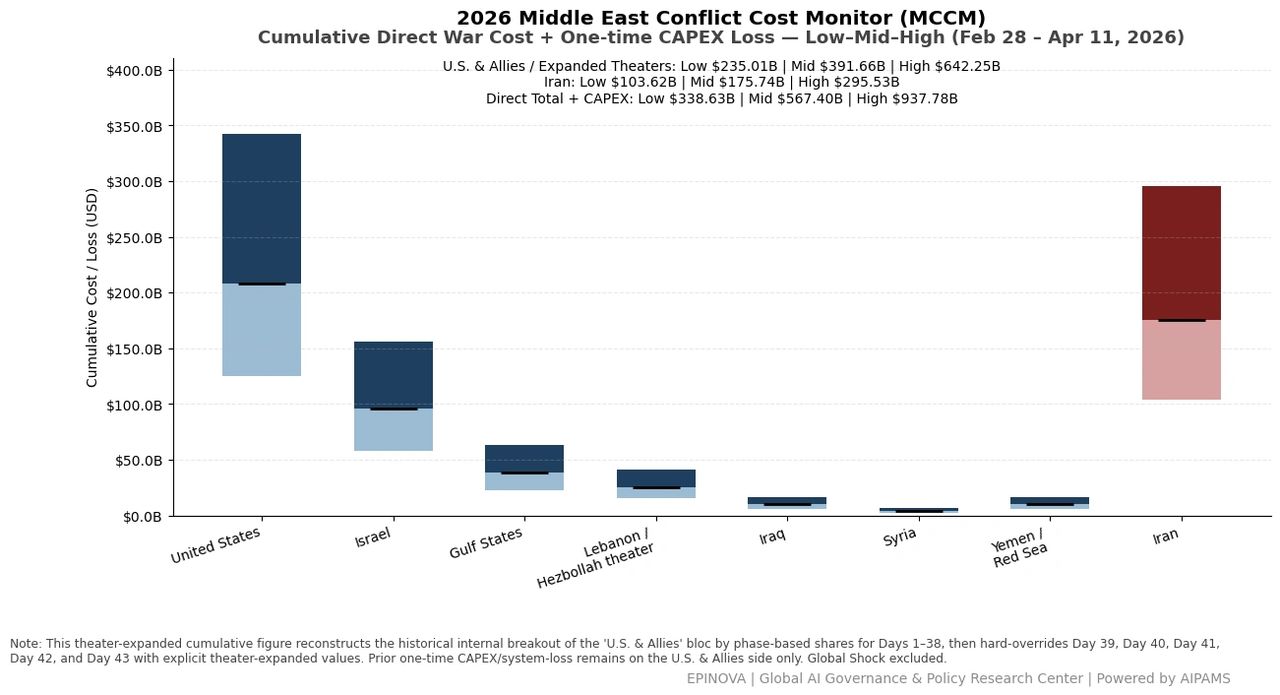
(1) Direct War Cost, which includes military operational expenditures, asset losses, and selected capital losses (CAPEX);
(2) Infrastructure and energy-sector disruption costs linked to conflict operations; and
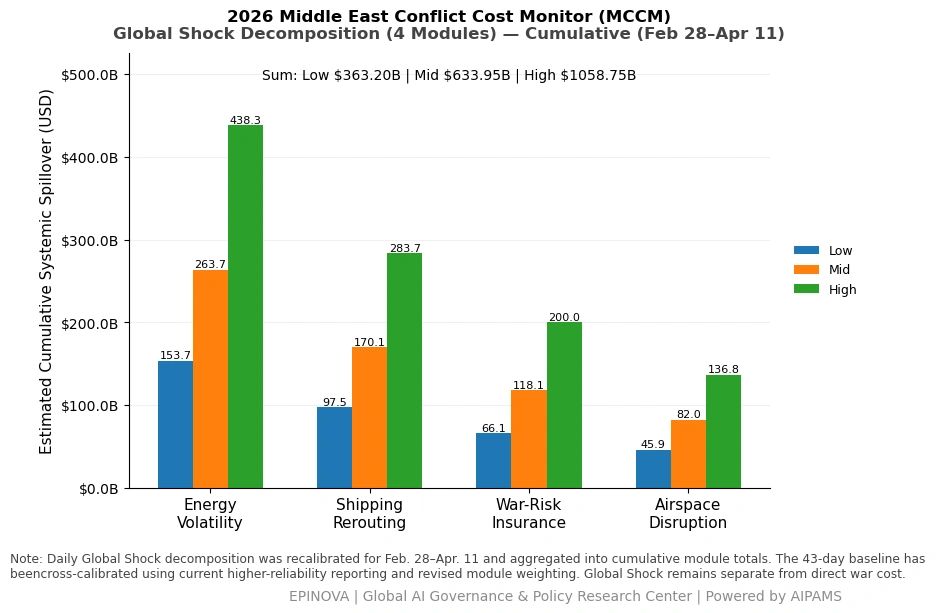
(3) Systemic market spillovers (“Global Shock”), which capture broader economic and logistical externalities associated with regional escalation.
Direct war costs and systemic spillovers are reported separately to maintain analytical clarity between conflict-specific expenditures and wider economic effects.
MCCM is designed as a rolling monitoring instrument rather than a definitive accounting ledger. Estimates are produced using scenario-bounded ranges intended to support comparative analysis and policy discussion rather than precise fiscal accounting. All values are expressed in current U.S. dollars (USD) and may be revised retroactively as verification improves and additional information becomes available.
As the conflict evolves, MCCM increasingly captures not only direct cost accumulation but also the dynamic interaction between military operations, strategic signaling, and systemic economic responses. In this sense, the framework has gradually developed from a cost-tracking model into a broader integrated exposure assessment system.
2. Methodological Notes
A. Scenario Ranges
All estimates are presented as bounded ranges:
- Low: Minimum confirmed observable losses.
- Mid: Most probable estimate based on publicly available reporting and operational cost parameters.
- High: Upper-bound scenario incorporating reported but not independently verified high-value asset losses.
B. Daily Estimates
Reported figures represent incremental 24-hour estimates of conflict-related costs and losses.
C. Cumulative Totals
Cumulative values reflect the aggregation of daily scenario ranges over the reporting period. High-range values may include scenario-based adjustments for reported strategic asset losses pending independent verification.
D. Global Shock
Global Shock represents systemic economic spillovers generated by the conflict, including both escalation-driven disruptions and temporary stabilization effects arising from partial de-escalation signals, such as controlled energy transit or diplomatic signaling.
It is decomposed into four modules:
- Energy Volatility
- Shipping Rerouting
- War-Risk Insurance Premiums
- Airspace Disruption
These modules capture the principal economic and logistical externalities associated with regional escalation.
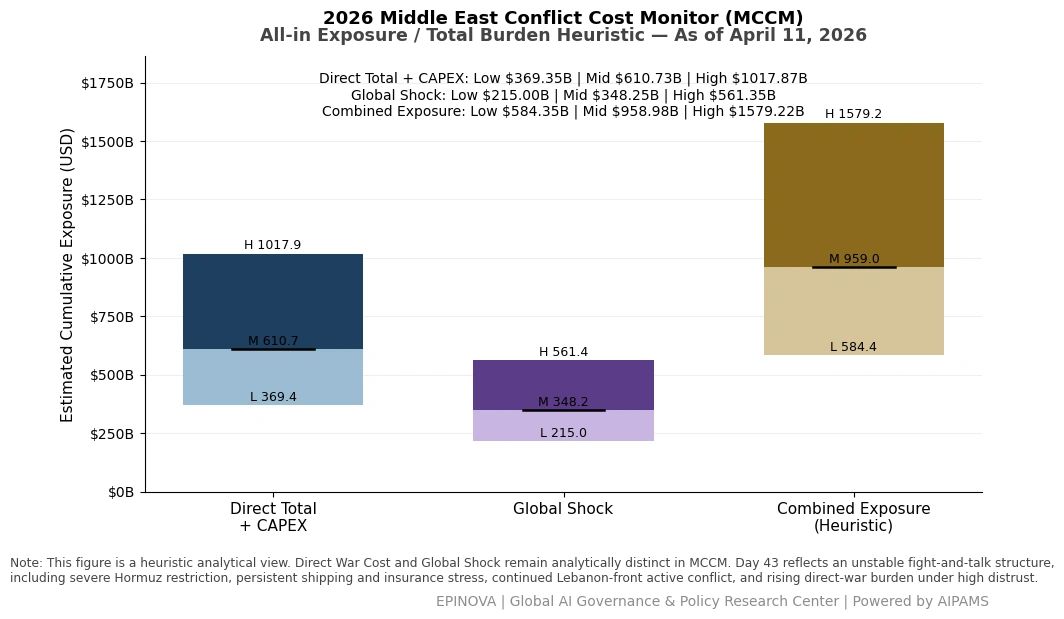
E. Combined Exposure
In selected figures, Direct War Cost and Global Shock may be displayed together as a Combined Exposure heuristic in order to illustrate the approximate scale of total economic exposure associated with the conflict.
This aggregation is analytical only and should not be interpreted as a formal consolidated fiscal account. Under conditions of high-frequency strikes and partial system stabilization, Combined Exposure may serve as a more informative indicator of systemic burden than isolated cost metrics alone.
F. Revision Policy
All MCCM estimates are derived from open-source reporting and model-based reconstruction and remain subject to revision as verification improves.
G. Structural Interpretation Note
At later stages of the conflict, cost accumulation alone may not fully capture strategic dynamics. MCCM therefore incorporates an exposure-oriented perspective, recognizing that relatively low-cost offensive actions may impose disproportionately high and persistent burdens on complex defense systems, infrastructure networks, and global market linkages.
This asymmetry can generate cumulative divergence in system sustainability, particularly under saturation conditions.
Selected References:
Associated Press. (2026, April 10). Lebanese bury 13 officers killed by Israel as conflict intensifies. https://apnews.com/article/394f8bdaee36bab82ab3ebc713221302
Associated Press. (2026, April 10). Stocks drift lower and oil prices ease ahead of U.S.-Iran talks. https://apnews.com/article/7ef6ebab1aaa731d2da6406b3cbde6dd
Associated Press. (2026, April 11). The latest: U.S. and Iranian officials meet face-to-face in Islamabad ceasefire talks. https://apnews.com/article/00bf6d9a8f19565dbcd437bc6bf09ea0
Associated Press. (2026, April 11). U.S. and Iran hold historic talks in Pakistan on war’s fragile ceasefire. https://apnews.com/article/2be904aee3f804892336730279e054b9
Reuters. (2026, April 8). Iraq’s Islamic Resistance suspends operations for two weeks. https://www.reuters.com/world/middle-east/iraqs-islamic-resistance-says-it-is-suspending-operations-two-weeks-2026-04-08/
Reuters. (2026, April 10). Global markets mixed and oil dips ahead of U.S.-Iran negotiations. https://www.reuters.com/world/china/global-markets-wrapup-1pix-2026-04-10/
Reuters. (2026, April 10). Lebanon says Israeli strikes killed security personnel in Nabatieh. https://www.reuters.com/world/middle-east/lebanon-says-israeli-attack-killed-13-state-security-personnel-nabatieh-2026-04-10/
Reuters. (2026, April 10). Oil posts steepest weekly drop since 2022 amid ceasefire expectations. https://www.reuters.com/business/energy/oil-prices-rise-after-strikes-saudi-oil-facilities-2026-04-10/
Reuters. (2026, April 11). U.S. military setting conditions to clear mines from Strait of Hormuz. https://www.reuters.com/world/asia-pacific/trump-says-us-forces-are-clearing-strait-hormuz-2026-04-11/
Reuters. (2026, April 11). U.S.-Iran negotiations begin amid doubts over Lebanon and sanctions. https://www.reuters.com/world/asia-pacific/us-iran-set-peace-talks-doubts-emerge-over-lebanon-sanctions-2026-04-11/
World Health Organization. (2026, April 9). Casualty and displacement update on Iran and Lebanon conflict. https://www.who.int/
央视新闻. (2026, April 10). 伊朗塞姆南省警方逮捕7名与敌对网络相关人员. https://news.cctv.com/
央视新闻. (2026, April 10). 西班牙首相谴责以色列打击黎巴嫩违反国际法. https://news.cctv.com/
央视新闻. (2026, April 11). 卡塔尔公布美军乌代德空军基地遭袭画面,雷达系统受损. https://news.cctv.com/
新华社. (2026, April 11). 伊朗教育部:美以袭击已致344名师生死亡. https://www.xinhuanet.com/
新华社. (2026, April 11). 美国和以色列对伊朗军事打击造成约2400人死亡、320万人流离失所. https://www.xinhuanet.com/
Share this post: